Tubular locks are the round-keyed locks found on vending machines, coin boxes, bike locks, cabinets and some alarm switches. Locksmiths who service them need a tubular pick that matches both the pin count and the size of the lock — which is why "7-pin" and "8-pin" are the first words buyers search for.
How tubular locks differ
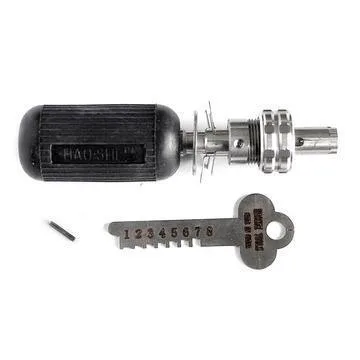
Instead of a row of pins, a tubular lock has its pins arranged in a circle around the face of the cylinder. The key is a tube with cuts around its end. A tubular pick works all the pins at once: small feelers set each pin while the tool turns the cylinder.
Once the lock opens, the feelers stay at the set depths, so many tubular picks can also be used as a reference for cutting a new key.
7-pin vs 8-pin
7-pin is the most common tubular format and the one most customers mean when they ask for "a tubular pick". 8-pin locks are used where a higher security version of the same design is wanted. A 7-pin tool will not work an 8-pin lock, so the pin count has to match.
Diameter matters as well: tubular locks come in a standard size and smaller sizes, and some have the alignment notch in an offset position. When a customer orders, ask for the pin count, the size and a photo of the key face — or send the photo to us and we check it.
What to stock first
- Start with the standard 7-pin tubular pick — it covers most service calls.
- Add 8-pin and smaller sizes when your customers ask for them, rather than stocking every size up front.
- Sell a cutting or decoding option alongside if your customers also make keys.
Tubular picks are in stock with no minimum order, so you can add a small quantity to any order.
Who buys tubular picks
- Vending and amusement operators — machines and coin boxes often use tubular locks.
- Bike shops — some cable and U-locks use tubular cylinders.
- Furniture, cabinet and locker service — office furniture and lockers.
- Security installers — some alarm and elevator key switches.
Knowing which of these your customers are tells you which sizes to stock.
Sizes and offsets explained
Tubular picks are usually listed by pin count and diameter — sizes such as 7.0, 7.5 and 7.8 mm are commonly sold, with the larger size often called "standard". The alignment notch can be in the centre or offset to one side, and the pick has to match that too.
For a reseller this means: list size, pin count and offset in every product title, and ask customers for a photo of the key face if they are unsure. Send the same photo to us and we confirm which of our models fits.
Questions to ask before you quote a customer
- How many pins does the lock have (count the cuts on the key)?
- What size is the key — standard or a smaller one?
- Is the notch centred or offset?
- Do they also need to cut keys after opening?
Four answers, one correct product, no returns.
Key terms
| Tubular lock | A lock with pins arranged in a circle and a round, tube-shaped key. |
|---|---|
| Pin count | Number of pins in the circle — usually 7, sometimes 8. |
| Diameter | The size of the key tube; picks are made for specific sizes. |
| Offset | Position of the alignment notch — centred or to one side. |
| Feelers | The small rods in a tubular pick that set each pin. |
Questions
Will a 7-pin tubular pick open an 8-pin lock?
No. The pin count must match the lock, and the size of the lock matters too.
Which tubular pick should I stock first?
The standard 7-pin size covers most vending, bike and cabinet locks. Add other sizes when customers ask.
Can I order just a few tubular picks?
Yes. In-stock tools have no minimum order.